Showing posts with label HR Analytics. Show all posts

Dec 12, 2018

Attrition Percentage By Reason @ Online Delivery (Boys) Business


For more details, reach at either info@tatvaai.com or mavuluri.pradeep@gmail.com

Find more about author at http://in.linkedin.com/in/pradeepmavuluri

Jul 1, 2016

Indian_IT_Cos_HR_Analytics_Hurdle

There has always been a question to me time-to-time (because of my earlier experience with developing HR platform for few big fortune clients), on “why Indian IT companies are not towards advanced HR analytics?”


Below is true for more than 90% of the Indian IT companies, 'since animal representing management cannot bypass an important layer, a big animal representing employees, which is a pseudo big (*), hence, jumping is almost impossible for implementing all those insights brought out or meant for employees'. Herein, one might guess a missing component which most of employees feel, of not much use in Indian IT companies context …………….?


Nov 18, 2014

Big Data HR Analytical Insights – Large Organization Performance and Growth Over a Period – Part 2

In continuation to the last post which was published last week BigDataHR_Part1, today I would like to highlight further insights on what happened when the organization went with penalizing mood for the average performers and rewarding higher performers. However, this was for one of their average earning revenue division over a period of time, herein also, organization has expected that growth will be exponential. But, it was for the shorter period (it took some momentum and pushed the division growth to good number) what happened later, whether growth momentum continued, again herein, I tried to summarize through below graph.


If actual growth momentum that was observed initially would have continued, then, organization’s business growth (cycle) should have taken the green line of business growth curve, since, now no more exists that heavy tyre as explained in the last post BigDataHR_Part1, that can push its pace down. However, it took course of red line, that resembling initial pick up in growth followed by flat line there after; one of the main reasons for this was that after certain period, high performer’s couldn’t alone drive growth with out the support of average performers was very clear in observation.

Nov 14, 2014

Big Data HR Analytical Insights – Large Organization Performance and Growth Over a Period – Part 1

Below graph, explains the summary of analytical insights obtained from a large organization’s performance data with respect to growth over a period of time. Presented results are obtained from one of their high revenue division, wherein, first identification of high performers and average performers happened. Said organization had rewarded their high performers promptly with larger benefits expecting that growth will be exponential. But, to surprise, next year they didn’t observed expected growth in the division. However, ignoring it, the same has been continued for the coming year, yet, not seen expected growth. Continuing the same policy, organization thought of giving a data-driven approach about what was happening?


When observed such large division performance and growth data over a period of time, following insights came out, which I tried to summarize through above graph. Organization was expecting a exponential form of growth curve year after year which is represented by green line of business growth (cycle) driven by rewarding high performer’s timely. However, organization had a large number of average performers, though they are not rewarded as good as compared to high performers, organization’s resource utilization towards them got out weighted such that high performers alone were unable to drive the growth cycle and it tilted down entire growth cycle to take slow paced curvy linear growth curve represented by red line.

Watch out for other Big Data HR Analytical Insights in coming posts.

Author has worked extensively in the HR Analytics and can be reached at mavuluri. pradeep@gmail for related discussions/projects.

Jun 3, 2014

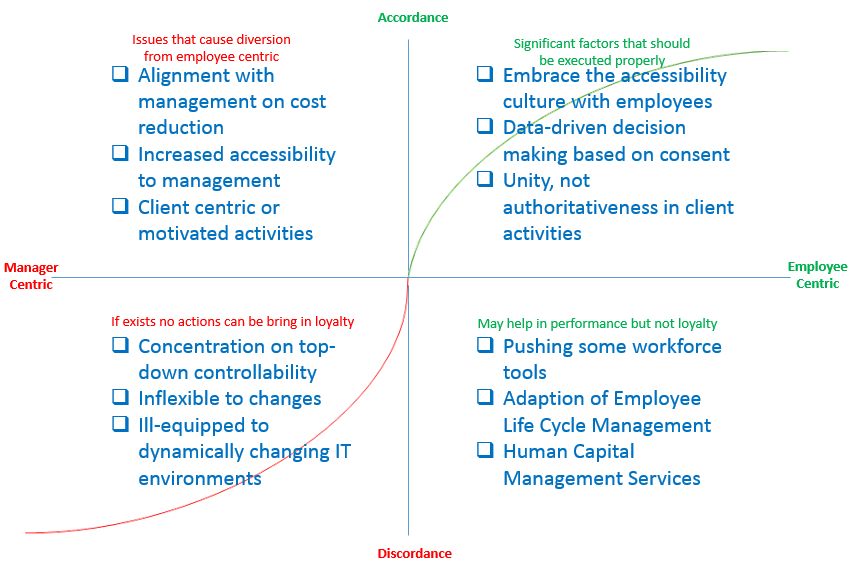
Operational HR Analytics - Moving from Manger Centric to Employee Centric

Below figure is depiction of one of those realistic patterns compendium with respect to the industry data which states why organizations should not be 'manger centric'.


Author has worked extensively in the HR Analytics and can be reached at mavuluri.pradeep@gmail for more details.

Mar 9, 2014

Analysis of HR Emails

This study has made an attempt to understand, what HR's in a day dealt with at different working hours, by analyzing their emails from a particular organization. Sample size of the study consists of 7 HRs emails who are located at two different locations of the same organization in a country and for 15 different days that are selected randomly from a quarter.

After sanitizing the data and removing unnecessary characters and punctuation's, data has been prepared and transformed in such a way to get frequency of words used by each hour. A day has been divided into seven categories viz., first hour, second hour, etc. Correspondence analysis has been chosen keeping in the mind for graphical representation of the processed data (below is the output - prepared for presentation purposes). All analysis has been carried out using open source statistical computing tool "R".


Analysis tells us that, 'First' hour of the day's had always been dealt with HR policies, queries, and aspects related to appraisal, roles and productivity (higher number of aspects (5) in first one hour). And, 'Second' hour went completely for addressing leaves and grievances of the employees. Coming to 'Third' the turn of reviews and offers, however, both second and third dealt with less number of aspects i.e. only two. Surprisingly, none of the aspects at the fourth hour. Moving to fifth hour again good number of aspects (4) have been dealt viz., payroll aspects of the employees, diversity and safety in the organization and about interviews. Sixth hour went for addressing training needs and calendar related aspects. Last hours (2.23 hours on average) has been dealt with development, retention and performance aspects.


Author has worked extensively in the HR analytics and can be reached at mavuluri.pradeep@gmail for related discussions.

Jan 13, 2014

Operational HR Analytics - Application to Attrition

As employee attrition continue to be expensive for organizations; businesses demanded increasing flexibility as interest in what can be done with Human Resource (HR) data and intensifying opportune in its preparation/planning are gaining pace, that, directs towards operational HR analytics.


As evident from above figure, reports (basic) are entirely backward looking aspect with less return on investment (ROI). Current phase is result of availability of increase in data across the organization and all-encompassing information technology progress that helps to predict what went wrong and integrate them with future outcomes. Majority of businesses today though uses predictive analytics for their organizations, return on investment had been slowed down and not effective as these analytics are not yet in the stage of adaptive application i.e. real time to the organizational operations/needs.

In current state of human capital management where dynamic workforce requirements, acute competition for talent, rapid technological advances not providing enough time to ingest for adoption and national/natural upheavals in one part affecting overall business in the other parts requires operational analytics that can foresee rising business needs of an organization. My experience with the help of open-source statistical computing environment viz. R, towards developing such environments had been yielding higher return on investment for businesses.

Author has worked extensively in the HR analytics and can be reached at mavuluri.pradeep@gmail for more details.